| Treatments
Bleaching
l Bonding
l Veneers
l
Enamel Shaping
l
Bad Breath
|
|
|
*************************************** |
|
|
|
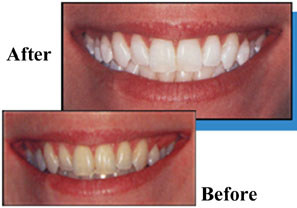
Bleaching
is a procedure that whitens teeth that are discolored,
stained, or have been darkened because of injury. It can be performed on
any tooth, even one that has had root canal treatment.
There are two types of bleaching procedures:
-
Chairside Bleaching -
done completely in the dental office,
takes 60 minutes per visit. A chemical solution, the
oxidizing agent, is 'painted' onto the teeth. Generally only 1 to 3 visits are necessary.
-
Home Bleaching - at home
daily treatment for up to 2 weeks. A
custom-fitted mouthguard is fabricated to hold a bleaching gel. The
home tray should be worn 1 hour per day for up to 2 weeks.
|
|
*************************************** |
|
|
|
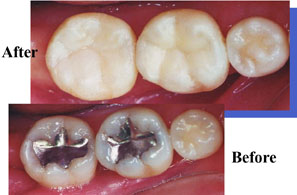
Bonding
is a procedure in which tooth-colored materials are
bonded to the surface of a tooth. Bonding covers discolorations,
repairs chips, breaks & cracks, and fills in gaps. It is a virtually
painless procedure that is usually completed in one visit. Periodically,
it may have to be recoated or replaced, since it usually lasts from 5 to
10 years.
The bonding process involves etching the tooth surface with a
conditioning solution that allows the bonding material (composite
resins) to adhere. To match your own teeth, various color resins are
carefully blended so the bonded tooth will look completely natural.
After application, the resin is contoured into the proper shape and
hardened using a special light. It is then smoothed
and polished to appear natural.
|
|
|
|
|
|
*************************************** |
|
|
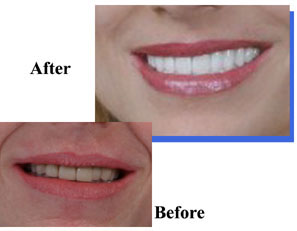
Veneers are thin custom made shells of tooth-colored materials
that are designed to cover the front side of teeth. They are fabricated
by a dental technician, usually in a commercial dental laboratory, from
a model provided by the dental office. Veneers are used to close gaps or
cover teeth that are stained, poorly shaped, or slightly crooked.
|
COULD YOU HAVE BAD
BREATH AND NOT KNOW IT? |
|
You could be one of the millions of Americans who suffers
from chronic bad breath (Halitosis). Studies indicate that 25 to 85
million people are affected.
The fact is, dentists at an American Dental Association Conference
reported that they faced a minimum of six patients with bad breath every
week. Calculating the number of practicing dentists, that adds up to at
least 500,000 bad breath cases weekly!
|
| How Do You Know
What Really Works? |
|
In a Consumer Reports test of 15 leading
mouth rinses, all were effective for 10 minutes. NONE worked for more
than two hours.
|
|
Halitosis might indicate
more serious oral care and dental related problems, such periodontal
(gum) disease and oral cancer.
|
| A simple
painless exam can determine the cause of your bad breath. |
|
|